

For many women, being diagnosed with endometriosis brings mixed emotions. At first, they feel relieved because they finally know the reason behind years of painful periods or pelvic pain.
At the same time, they are also concerned;
“Doctor, does endometriosis affect fertility?”
“Can I still be able to get pregnant?”
If you have these questions, you are not alone. It is important to know that endometriosis affects every woman differently and their fertility too.
But what causes it?
This occurs due to this condition is linked to many factors that impact your fertility.
In this article, we discuss how endometriosis affects your fertility and the possible treatments to increase your chances of conceiving.
How Endometriosis Damages the Reproductive Organs?
Reproductive organs such as your ovaries, fallopian tubes and uterus must work effectively to achieve pregnancy. But if you have endometriosis, this may impact your reproductive organs’ function.
Endometriosis tissue does not stay in one place. Over time, this tissue can irritate surrounding tissues and lead to the formation of small patches of scar tissue. These can affect your ovaries, fallopian tubes and uterus.
With progression of the disease, the scar tissue may cause nearby organs to stick together. This can change their normal position and affect the movement of the egg through your fallopian tubes. As a result, it may become more difficult to get pregnant naturally.
According to the American Society for Reproductive Medicine, around 30 to 50 out of every 100 women with endometriosis experience infertility. This highlights the close link between endometriosis and fertility problems.
The Role of Inflammation in Fertility Failure:
Inflammation simply means your body’s immune system responds to any injury or infection. Its function is to help your body heal.
But in endometriosis, the inflammatory response continues for a long time. It is one of the main factors that disturbs your fertility.
But how does inflammation affect your fertility?
When endometrial tissue grows outside your uterus, your body releases some inflammatory substances. These substances create an unhealthy environment around your reproductive organs.
According to a study in 2025, inflammation may affect your fertility in the following ways:
- Affect your egg development
- Decrease sperm mobility and thus affect fertilization
- Decrease the likelihood of implantation of the embryo
Can all of the above changes happen in mild endometriosis?
Yes, even if you have mild endometriosis, inflammation may decrease your chances of conceiving.
How Endometriosis Affects Egg Quality and Ovarian Reserve?
Ovarian reserve, in simple terms, your egg quantity. You are born with many eggs, but as you age, your egg count decreases. So, how many eggs are left in your ovaries is your ovarian reserve.
Not only your egg quantity, but your egg quality is important for a healthy pregnancy.
When endometriosis affects your ovaries, it can over time cause the formation of a chocolate cyst. It is also called an endometrioma. This cyst damages healthy tissue in your ovaries and affects how your ovaries work.
Research published in Biomedicines (2021) suggests that ongoing inflammation and oxidative stress associated with endometriosis can also affect your egg development, reducing egg quality.
Endometriosis and Implantation Problems:
Pregnancy depends not only on fertilization but also on implantation. Implantation refers to the attachment of the fertilized egg into your uterine lining.
But women with endometriosis face implantation problems. These are a result of continuous inflammation and changes in hormones, making it difficult for your uterine lining to prepare for embryo implantation.
A 2022 review study suggests that changes in your immune system and the way your body responds to the hormone progesterone may make it harder for the uterine lining to support embryo implantation.
Adenomyosis is another factor that is related to endometriosis. In this case, the endometrium grows inside the muscles of your uterus.
According to a study, adenomyosis affects the uterine muscle and makes your uterus less favorable for implantation.
Can Women with Endometriosis Still Get Pregnant?
Yes. If you are diagnosed with endometriosis, it does not mean you can not get pregnant. In fact, women who have this condition still conceive naturally.
According to Pregnancy, Birth and Baby, about 1 in 3 women with endometriosis may have difficulty getting pregnant.
But, many women have a question: “What are my chances of getting pregnant with endometriosis?” “Is it similar to women who have no endometriosis?”
“For couples without endometriosis, the chance of getting pregnant is about 15–20% each month. If endometriosis is left untreated, this chance may drop to around 2–10%, depending on how severe the condition is.”
Dr Atishay Jain, Endometriosis & Gynae Laparoscopy Specialist
The chances of getting pregnant with endometriosis vary from person to person. They depend on many factors such as:
- Your age
- What stage of endometriosis you have
- Your ovarian reserve
- Health of your fallopian tube
- Male fertility
Endometriosis also increases the risk of certain pregnancy complications, endometriosis pregnancy loss (miscarriage) and preterm birth.
Let’s understand how we can improve your chances of pregnancy if you have endometriosis.
Treatment Options That Improve Fertility in Endometriosis:
Your treatment depends on the severity of your endometriosis, the length of time you have been attempting pregnancy and your overall fertility potential.
Here are some available options to treat your infertility due to endometriosis:
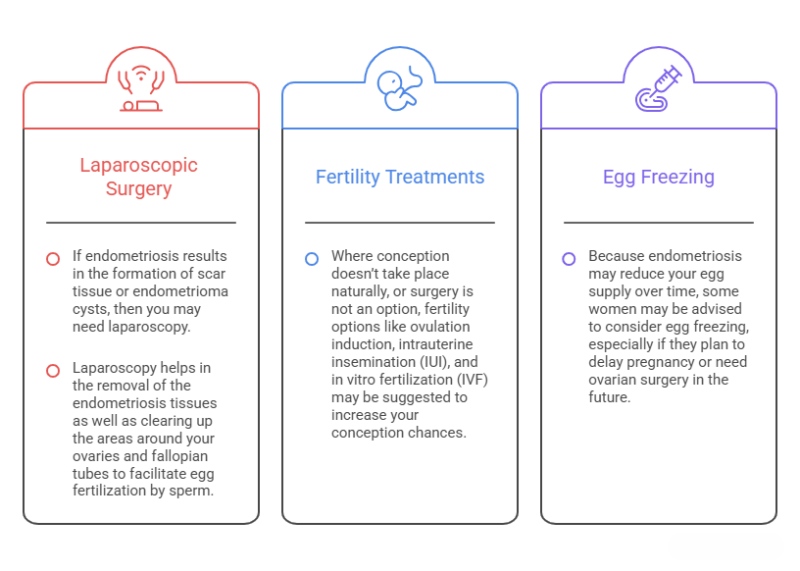
Laparoscopic Surgery:
If endometriosis results in the formation of scar tissue or endometrioma cysts, then you may need laparoscopy. Laparoscopy helps in the removal of the endometriosis tissues as well as clearing up the areas around your ovaries and fallopian tubes to facilitate egg fertilization by sperm.
Fertility Treatments:
Where conception doesn’t take place naturally, or surgery is not an option, fertility options like ovulation induction, intrauterine insemination (IUI), and in vitro fertilization (IVF) may be suggested to increase your conception chances.
Egg Freezing:
Because endometriosis may reduce your egg supply over time, some women may be advised to consider egg freezing, especially if they plan to delay pregnancy or need ovarian surgery in the future.
Why Choosing the Right Specialist Matters:
Endometriosis can affect every woman in a different way. In some women, it mainly causes pain. In others, fertility is the biggest concern. Understanding exactly how the condition is affecting your body is the first step towards the right care.
An experienced specialist can guide you through your options and help you make confident decisions about your pregnancy journey.
Take the First Step Toward Fertility:
If endometriosis is making your pregnancy journey difficult, you don’t have to face it alone. The right guidance at the right time can make a real difference. Consult Dr Atishay Jain, Endometriosis and Advanced Gynecologic Laparoscopy Specialist based in Indore, to discuss the treatment options best suited to your fertility goals.
FAQs:
Yes, you can still get pregnant with endometriosis. Many women conceive naturally, though fertility challenges may arise depending on your age, endometriosis stage, ovarian reserve, and overall reproductive health.
Endometriosis can reduce your monthly conception rate from 15–20% down to 2–10% if untreated. It affects egg quality, blocks fallopian tubes, and disturbs implantation, making natural pregnancy more difficult but not impossible.
No, not at all. Around 30–50% of women with endometriosis face infertility issues, but many others conceive without any problem. The impact on fertility depends on how severely your reproductive organs are affected by the condition.
An endometrioma, also called a chocolate cyst, forms on your ovaries due to endometriosis. It damages healthy ovarian tissue, reduces your ovarian reserve, and lowers egg quality — all of which make conceiving naturally more challenging.
Fertility can be affected at any stage of endometriosis, including mild (Stage I & II). However, advanced stages (Stage III & IV) with extensive adhesions, blocked tubes, and large endometriomas cause more significant damage to reproductive organs and fertility potential.