

Endometriosis happens when tissue similar to your uterine lining grows outside of your uterus. This tissue may be found in your ovaries, fallopian tubes, or other pelvic organs.
Because it is outside of your uterus, the blood and tissue cannot leave your body normally. Over time, this can lead to irritation, inflammation, scar tissue, and pelvic pain.
Does endometriosis affect all women in the same way? The answer is no. So, how do we know the extent of endometriosis?
For this, we use stages of endometriosis. These stages help us to know the extent of disease spread and which pelvic organs are involved.
In this article, we explain how endometriosis is staged, its symptoms by stage and how it helps guide your treatment.
How Is Endometriosis Classified? Understanding the ASRM Staging System
When we diagnose you with endometriosis, our first step is to determine how far the endometrial tissue has spread.
To understand this, we use the ASRM (American Society for Reproductive Medicine) endometriosis classification. This classification is an earlier revision of the AFS scoring system.
During laparoscopy, we look for the following points:
- How much of your endometrial tissue is present
- How deep it has grown
- Whether there are ovarian cysts (chocolate cysts)
- Whether adhesions (scar tissue) form
- Any involvement of other pelvic organs
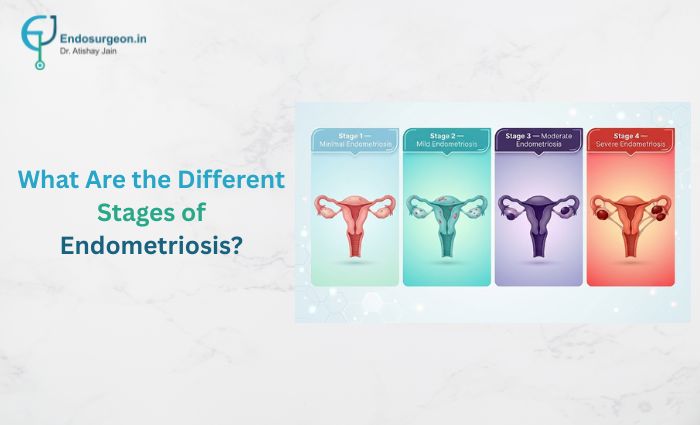
Based on the above findings, we classify your endometriosis as stage 1 to stage 4.
Based on a review study, the following table shows how common each stage of endometriosis is.
| Stages Of Endometriosis | How Common Is It? |
| Stage I (Minimal) | 20% |
| Stage II (Mild) | 13% |
| Stage III (Moderate) | 5% |
| Stage IV (Severe) | 2% |
Let’s look at every stage of endometriosis in detail.
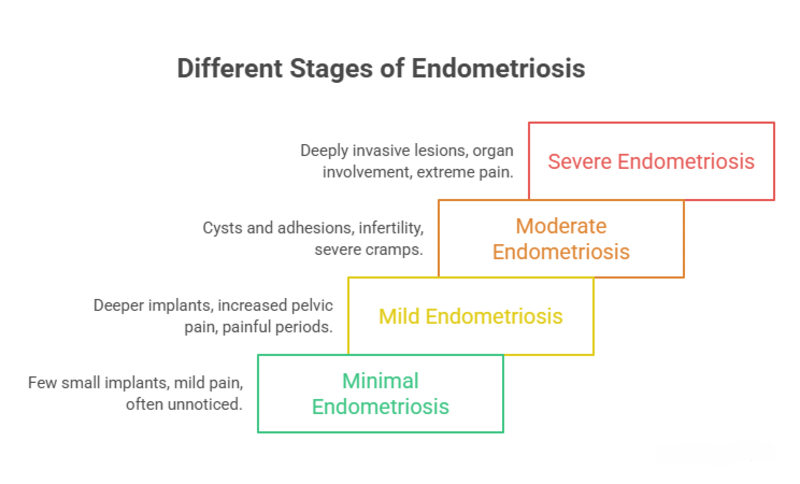
Stage 1 — Minimal Endometriosis: What It Looks Like
If you are diagnosed with Stage 1 (Minimal) endometriosis, it means the disease is in its earliest stage.
The key features of stage 1 endometriosis are as follows:
- Only a few small areas of endometriosis implants or lesions are present.
- The growths are usually shallow and do not spread deeply.
- There is little or no scar tissue.
- Your ovaries and fallopian tubes are generally healthy.
Symptoms of stage 1 endometriosis are as follows:
- You feel mild pain
- You may experience occasional pain before or during periods
- You feel possible pain during intercourse
This stage is mostly unnoticed due to mild or no symptoms. Because many women mistake this pain for normal menstrual pain.
Stage 2 — Mild Endometriosis: Deeper Implants Begin to Form
When you have been diagnosed with Stage II Endometriosis (Moderate), it signifies that the condition has progressed slightly from the initial stage.
Stage 2 endometriosis has certain characteristics; they include the following:
- There may be one or more locations in the pelvis where you have developed an endometriosis lesion or implant.
- The lesions are likely to have attached to tissue and penetrated deeper than they were at stage 1.
- Scar tissue may begin to appear around the affected areas.
The symptoms of stage 2 endometriosis include the following:
- There is an increase in pain in the pelvis area, particularly during your menstrual period
- You have painful menstruation
- You have lower back pains
- Painful sexual intercourse called dyspareunia
- You may also have some gastrointestinal symptoms such as bloating and constipation
You may also notice that your endometriosis symptoms can begin around this same time and can make it difficult for you to complete your daily activities.
Stage 3 — Moderate Endometriosis: Cysts and Adhesions Develop
If you are diagnosed with stage 3 or Moderate endometriosis, it shows that your disease is quite progressed.
Here are key features of stage 3 endometriosis:
- Endometrial implants that extend into the adjoining tissues
- Ovarian cysts or “Chocolate cysts” or endometriomas
- Mild adhesions
- Your fallopian tubes and ovaries can be affected, making conception difficult
Here are the common symptoms of stage 3 endometriosis:
- Pain in your pelvis
- Painful menstrual cramps
- Menstrual bleeding in excess
- Pain during sexual intercourse
- Infertility
- Fatigue and gastrointestinal problems
Stage 4 — Severe Endometriosis: The Most Advanced Form
If you have been told you have Stage 4 (Severe) endometriosis, then this implies that the condition is advanced and that it involves multiple pelvic organs.
The following are some of the characteristics of stage 4 endometriosis:
- Deeply invasive lesions or implants
- Large cysts that affect both ovaries
- Adhesions where several organs may get joined
- The scarring process may result in joining together of your pelvic organs or moving them from their correct positions
The following are the symptoms that you will experience at this stage:
- Extreme pain in the pelvic region
- Pain during your whole period
- Difficulty in conceiving
- Extreme tiredness
- Pain during bowel movements or urination due to involvement of the bowel or bladder
Does the Stage of Endometriosis Determine the Treatment?
Not always. One of the biggest misconceptions is that your treatment depends only on the stage of endometriosis. We also consider your symptoms, age, fertility goals, the location of the disease, and how much it is affecting your daily life.
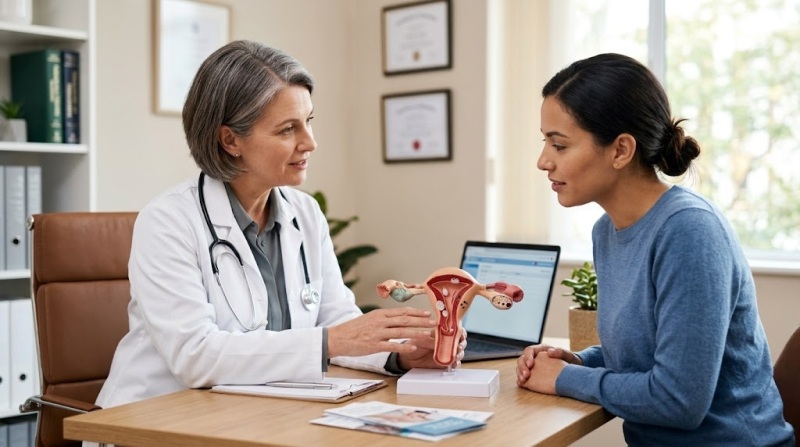
For example, the stage 1 patient may experience severe pain, whereas the stage 4 patient has fewer symptoms but still requires surgery in order to remove disease lesions and improve her chances of conceiving.
Depending on your condition, treatment may include:
- Pain-relieving medicines
- Hormone therapy
- Laparoscopic surgery
- Other fertility treatment
Dr Atishay Jain, an Endometriosis and Gynaec Laparoscopy Specialist, says,
“If your symptoms are affecting your daily life, do not ignore them just because you have been told your endometriosis is ‘mild.’ The right treatment starts with understanding how the condition is affecting you, not just what stage it is.”
Can Endometriosis Progress from One Stage to Another?
Yes, it can, but not for everyone.
According to the 2022 ESHRE Guideline on Endometriosis, endometriosis is a chronic condition, and its progression varies from one woman to another. Your endometriosis may progress over time, while for someone else, it may remain stable for years.
Because of this, regular follow-up is important. It allows us to monitor your condition, adjust your treatment when needed, and help reduce the risk of future complications.
When Should You See a Specialist About Endometriosis Staging?
If you have been dealing with these symptoms for months or they keep coming back, do not ignore them. Consider seeing an endometriosis specialist if you have:
- Severe period pain
- Ongoing or chronic pelvic pain
- Pain during intercourse
- Difficulty getting pregnant
- Persistent ovarian cysts
- Symptoms that do not improve with medication
With the right diagnosis and timely treatment, you can better manage your symptoms and protect your fertility. Dr Atishay Jain uses laparoscopic assessment when required to determine the stage of your condition and recommend the most appropriate treatment for you.
FAQs:
Endometriosis is classified into four stages of endometriosis — Stage 1 (Minimal), Stage 2 (Mild), Stage 3 (Moderate), and Stage 4 (Severe) — based on how far the endometrial tissue has spread, how deep the lesions are, and whether adhesions or ovarian cysts are present.
The stage of endometriosis is determined through a surgical procedure called laparoscopy, where the doctor directly views the pelvic organs, checks for endometrial implants, scar tissue, and chocolate cysts, and assigns a stage based on the ASRM scoring system.
Chocolate cysts, also called endometriomas, are ovarian cysts filled with old blood that appear dark brown in colour. They typically develop from Stage 3 or Moderate endometriosis onwards and can affect ovarian health, making it harder for women to conceive naturally.
Endometriosis treatment depends not just on the stage but also on your symptoms, age, and fertility goals. Options include pain-relieving medicines, hormone therapy, and laparoscopic surgery. Even Stage 1 patients may need surgery if pain is severe, while Stage 4 patients usually require surgical intervention.